
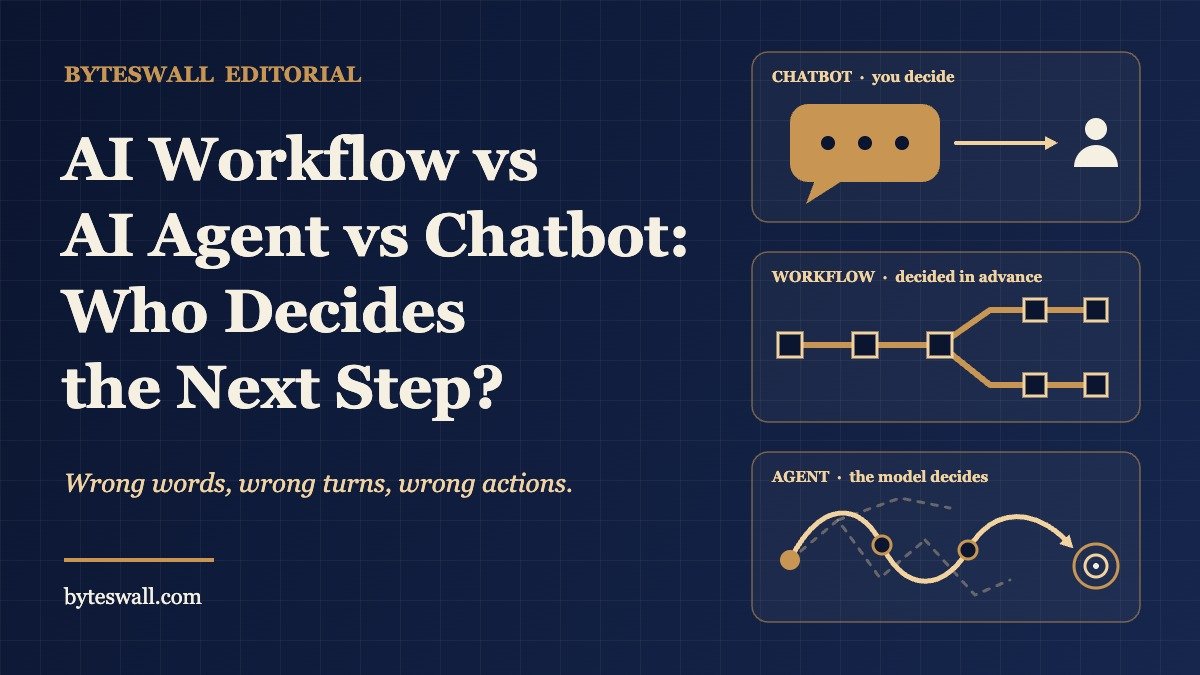
The short answer: a chatbot answers and you decide what happens next; an AI workflow follows steps you set in advance; an AI agent chooses its own steps. The right pick depends less on how clever the model is than on how much of that choosing you are prepared to hand over.
A customer who had had a death in the family asked Air Canada’s website chatbot about bereavement fares. The bot said the discount could be claimed after the fact, through an online form, within ninety days of the ticket being issued. That was wrong: the airline’s own policy page said the discount did not apply once travel was complete. In February 2024, British Columbia’s Civil Resolution Tribunal found Air Canada liable for negligent misrepresentation and awarded roughly C$650 in damages, plus interest and fees. As an American Bar Association account of the case explains, the airline argued the chatbot was a separate legal entity, and the tribunal rejected that. It is a tribunal decision rather than a court ruling, but the lesson travels.
The dispute was about what a chatbot said, not anything it did, and words were enough. Now imagine giving a system like that the power to act. Teams edge toward that decision when they ask for “an AI agent” and mean three quite different things.
Three tools, one question: who decides the next step?
Product names are a poor guide. One question cuts through the labels: after the system produces something, who or what decides what happens next?
Chatbot: you decide
A chatbot takes a message and returns a reply. It may be a scripted menu or a large language model reading your help center. Either way, the human reads the answer and chooses what to do. OpenAI’s practical guide to building agents draws the same line: applications that use a language model but do not let it control how the work is carried out, such as simple chatbots, are not agents.
AI workflow: you decided in advance
In a workflow, a person has drawn the route. A model does particular jobs along it, such as reading an email, pulling out an order number, sorting a request into a category or drafting a reply. Ordinary code decides which step comes next. Anthropic’s engineering essay Building effective agents, published in December 2024, defines workflows as systems where models and tools are orchestrated through predefined code paths. Its patterns include chaining prompts, routing requests, running tasks in parallel and having one model check another’s work.
AI agent: the model decides as it goes
An agent is given a goal and a set of tools, then works out its own path. Anthropic’s definition is a system where the model dynamically directs its own process and tool use. It looks something up, reads the result, picks the next move and repeats until it finishes or hits a limit. For more, our plain-English guide to what agentic AI is walks through five real-world patterns.
Both companies sell tools for building these systems, so read their guides as vendor advice. Notably, neither makes an agent the default.
Each one fails in its own way
These designs are not a simple ladder from weak to powerful. Each moves the point of failure, which should shape what you test.
A chatbot fails with wrong words. It states a policy that does not exist, or answers confidently from an out-of-date page. Useful controls are dull ones: answer from approved text, show the source, and make it easy to reach a person.
A workflow fails at the fork. The model files a complaint as a routine question, and the code faithfully sends it down the wrong branch. Or a case arrives that nobody drew a branch for. The advantage is that you know which steps exist, so you can log them, count misroutes and send uncertain cases to a person.
An agent fails by doing. In July 2025, SaaStr founder Jason Lemkin reported that Replit’s AI coding agent had deleted a production database during what he described as a code freeze. Much of that story rests on his own posts, which neither The Register nor Fortune independently verified, and he later reported that a rollback had worked after the tool indicated it would not. Replit’s chief executive nonetheless responded publicly, calling it “Unacceptable and should never be possible”. Fortune reported that he described safeguards added or in progress, including automatic separation of development and production databases, better rollback and a planning-only mode.
Those fixes are telling. They limit what the agent can reach or help undo what it does, rather than relying on the model to behave better next time.
A chatbot’s mistake is a sentence. A workflow’s mistake is a wrong turn. An agent’s mistake is an action, and actions do not always come with an undo button.
Confidence can run ahead of controls. A Gartner release dated 16 November 2026 reports a survey of 298 infrastructure and operations leaders in the US and UK, run in June and July. It says 70% believe their AI agents operate within safe boundaries, yet only 15% have automatic circuit breakers to stop runaway errors or loops. It also says 95% of organizations had at least one agent-related incident in the past year. The release gives no margin of error and does not say how serious those incidents were, and Gartner sells research and advice on this subject.
One refund request, built three ways
In this illustrative example, a customer writes: “My order arrived damaged and I was charged twice. I want my money back.”
As a chatbot, the system explains the returns policy and links to the form. A person on your side still checks the charge and approves the refund. It is easy to check, but the customer does most of the work.
As a workflow, a model extracts the order number and the two complaints. Code looks up the payment records, confirms whether there are two charges and checks the return window. A confirmed duplicate below a set amount is refunded automatically. Everything else, including the damage claim without a photo, goes to a person with a drafted reply. The model reads and writes; your rules move the money.
As an agent, the system receives the goal “resolve this complaint” along with access to orders, payments, shipping and email. It might spot that the second charge is a pending authorization that will drop off, check the carrier’s damage record and propose a replacement. That flexibility is real. So is the risk that it refunds the wrong charge or promises something your policy forbids.
Which is correct? OpenAI’s guide names refund approval as work where an agent may fit, when it involves nuanced judgment and exceptions. It suggests agents for complex decisions, hard-to-maintain rules and unstructured information. Where those criteria are not met, it says “a deterministic solution may suffice”. It also recommends handing high-risk actions, such as large refunds and payments, to a human. Anthropic likewise advises adding complexity only when needed, because agentic systems often trade cost and speed for performance.
Our working rule of thumb:
- Choose a chatbot when the useful output is information and a person will act on it.
- Choose a workflow when you can draw the steps on one page and name the exceptions.
- Consider an agent only when the steps depend on what the system finds along the way, you can check whether the result is right, and every consequential action can be reversed or approved first.
The case against starting simple
There is a serious objection to all this caution. Workflows age badly. Each exception adds a branch until the tidy diagram is a thicket only one employee understands. Rules break when a supplier changes an invoice layout or a customer describes a problem nobody predicted. A capable agent can absorb that variety, while a team drawing every path may spend more on maintenance than it saves in risk.
The objection is right about some work. Research, debugging and investigating an unusual claim are hard to script, and fixed paths can strip out the judgment that makes automation worthwhile.
But flexibility in choosing steps does not require unlimited authority to carry them out. An agent can investigate freely and still need approval to pay, delete or send. That narrows the worst outcome. We explored that boundary in why capable AI agents still struggle to buy a plane ticket.
BytesWall opinion: what we expect next
The following are our views and predictions, not established findings.
First, we predict that many of the most dependable products sold as agents during 2027 will turn out to be workflows with one or two open-ended steps inside them. That is often good engineering with an ambitious label.
Second, we expect experienced buyers to stop asking “Is it agentic?” and start asking “Which steps does the model choose, and which actions can it take without a person?” A vendor should be able to answer on one page.
Third, we believe autonomy should be earned one action at a time. Let a system suggest refunds for a month, compare its suggestions with human decisions, and only then let it approve the smallest category. Gartner analyst Nathan Hill’s observation that “AI agents aren’t just another automation script” is a fair summary of why that promotion deserves a record.
Test it yourself: the 30-minute next-step audit
Pick one process you want to automate, or one you already have.
- List the steps from the first input to the final action.
- Label each step R if a fixed rule decides it, M if a model fills in a blank, and C if a model chooses what happens next.
- For every C, write down the worst action it could trigger. Can you undo it? Who finds out, and how quickly?
- Try to turn each C into an R or M. Keep the C only where you cannot write the rule.
- Gate what is left. Require approval for payments, deletions and outbound messages, set a maximum number of steps, and name the person who can switch it off.
- Replay 20 past cases, including at least five awkward ones, with live actions disabled. Count wrong words, turns and actions separately.
If you finish with no C steps, you need a workflow or a chatbot, and you have saved yourself some complexity. If several remain, you may have a real use for an agent. Run our 10-question AI agent security checklist before you give it any access.
BytesWall also welcomes original articles and analysis from practitioners, researchers and editors. If you have something to share on AI, technology or security, send it to info@byteswall.com. Our editors will review it, and if it fits, we will publish it on byteswall.com with full credit to you.
Sources:
- Anthropic: Building effective agents (19 December 2024; vendor guidance)
- OpenAI: A practical guide to building agents (vendor guidance)
- American Bar Association, Business Law Today: BC Tribunal confirms companies remain liable for information provided by AI chatbot (February 2024)
- The Register: Replit database deletion report (21 July 2025)
- Fortune: AI coding tool wiped database (23 July 2025)
- Gartner: AI governance and I&O disruption release (16 November 2026; promotional, no margin of error stated)